Saturday, February 27, 2016

Book Review: Are We Born Racist? by Jason Marsh et al

Are We Born Racist? is a book you need to read if you want to talk about race and racism. It’s an overview of the neuroscience behind racism.

The answer to the question posed in the title of the book is: Yes.

The book goes on to argue that there is no way to overcome the affects of racism in our culture unless we are willing to accept that fact.  From an essay in the book by David Amodio:

"The brain cannot be antiracist, per se, because [the amygdala] never stops spotting differences and sorting people into categories. But [the brain] is progoaland if the goal is to make judgments without regard to race, the [neocortex] can do that, though it may take a bit of effort and practice.
...
"In other words, egalitarianism is a skill, and people can learn from their experiences to respond without prejudice.
...
"The new psychology of racism suggests that simply suppressing prejudiceor trying to directly eradicate bias as it's activated in the brainwill not ultimately work. Instead we have to let the amygdala do its job, and train ourselves to help the neocortex do its job."

One thing to book makes clear is that there are different kinds of racism: ideological, structural, and biological. And the kind of racism that most people fall into is not the ideological “my race is better than your race” kind of claptrap. It’s the unconscious biological racism of people who are intellectually opposed to it.

Other interesting ideas discussed in the book:

*If a person is subject to prejudice, think they are subject to prejudice, or feel like they have to represent their minority group, they tend to performing below their skill level.

*People who are  bi-cultural tend to do better than their single cultural socio-economic peers.

*People who are not racist tend to come across as more racist in social settings than people who are actually racist.

*Color blindness — the idea that we should ignore race — actually promotes racist behavior.

Book Review: The Man in the High Castle by Philip K. Dick

The Man in the High Castle is a weird book that plays with a lot of challenging ideas regarding racial and cultural norms. But it’s ultimately unsatisfying as a story.

Written in the 1960s, it’s set in an “alternate present” where the Axis have won WWII. The Pacific States of America are a Japanese territory. The eastern US is allied with the Reich, and what is left of the old US exists in the Mountain west.

Most of the action takes place in the Pacific States. In an amusing turning of the tables, kitschy pre-war Americana is all the rage among the Japanese. Everything from Colt .45s to authentic Mickey Mouse watches are in such high demand that a thriving trade in counterfeits has arisen. This is a fun counterpoint to the anime, ninjas, samurai swords, and various Japanese things that are prevalent in our US culture.

The book is also interesting as a contemplation of the notion of race. In the Pacific States the Japanese race is the dominant one. Japanese looks define beauty. Pasty white, tall, big nosed Americans are obsessed with trying to look more Japanese so they can be “beautiful”. Though technically equal, white Americans are made to understand they are inferior to those of Japanese descent. Jews and people of African descent have an even worse time of it.

And this is where I think the book goes a little too far. Black people clearly get the shortest end of all possible sticks in this new world order. The problem is, until right at the very end, there are no black characters. So this depiction comes across as a bit unconsciously racist on the part of the author.

But the real problem with the book is how it’s written. It’s choppy and aimless. I later read that the author used the I Ching to plot the story, and it shows the signs of having been organized in a random and haphazard fashion.

The Man in the High Castle is a book full of great ideas, particularly its musings on race and culture, and is worth a read for that reason. The plot, on the other hand, leaves much to be desired.

Wednesday, December 23, 2015

Book Review: The Citadel of the Autarch by Gene Wolfe

I’ve decided that the only good science fiction novel is one that can never, under any circumstances, be made into a movie worth watching. Such cinematic capacity just doesn’t exist. Genre science fiction books are too weird, too transgressive, and too cerebral while also demanding too much in the way of expensive special effects in order to convert them to the big screen. Perhaps some day when dazzlingly realistic special effects can be produced practically for free you’ll get weirdo art movies with visual effects as captivating as those in /Interstellar/ or /Star Wars/. But not now.

Conversely, if you’ve ever seen a good science fiction movie, it was probably not based on an award winning science fiction novel. They’ve tried, of course: Dune, Starship Troopers, and a few other awkward viewing experiences. And they’ve failed.

Why do I say all this? Well, this is a review of Gene Wolfe's /The Citadel of the Autarch/ which will never, ever, ever be made into a movie. And that’s a good thing. The games that the author plays can only be done with written language. There were times while reading the book were I said to myself, “No way, Mr. Wolfe. There is no way you are going to be able to do what you’ve just told me you are going to do.” Then he goes and does it with such brilliance that it took me out of the story marvelling at his imagination and craft.

Is it a good thing when an author writes so well that you stop thinking about the story? Now that is not the only problem with the book. There continues to be the sense that he tries a bit to hard to align with genre conventions. At one point in the book he seems to have run into a narrative dead end and, quite literally, plucks his protagonist out of the path he’s on and compels him along the path he’s supposed to follow, all while having characters comment obliquely on the failings of “deus ex machina” narrative tropes.

Though the closing chapters drift into philosophical abstraction, and there is not much in the way of resolution, the story is powerfully and beautifully written. And it’s so chocked full of ideas that I feel a slight compulsion to go back to volume one and start reading /The Book of the New Sun/ all over again.

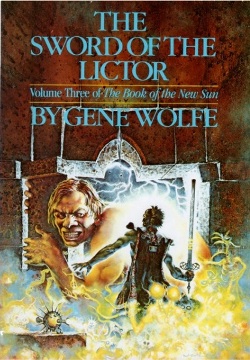
Book Review: The Sword of the Lictor by Gene Wolfe

/The Sword of the Lictor/ by Gene Wolfe is, so far, the most concrete and coherent book in the series. Or it might be that I am starting to adjusting to Wolfe's narrative style.

This interesting thing about this book is that, like previous volumes, retains the episodic nature of a pulp sci-fi story. But it’s not really clear to me how each individual episode relates to the overall story.

In this book we get the following episodes: “Thrax”, “The Cabin in the Mountains”, “The Village of the Magicians”, “Typhon”, and finally “Lake Diuturna”. The first episode seems to discard all that has been built up in the previous book. The following three episodes introduce additional complications, but by the time we get to the last episode, it seems like everything has been reset.

I would almost be tempted to think that the author was just making up random stuff as he goes, but his prose is so careful and each story seems to be so fraught with meaning that I can’t help but think it’s more than just a sequence of engaging, and often tragic, but loosely related short stories. That each step is an important piece of a larger puzzle.

While the first book in the series ended randomly and the second just kind of trailed off, /The Sword of the Lictor/ does culminate in a fantastic confluence of events and a rousing conclusion.

Overall I’m starting to warm to the series and the series itself seems to finally be finding what it wants to say.

Sunday, November 22, 2015

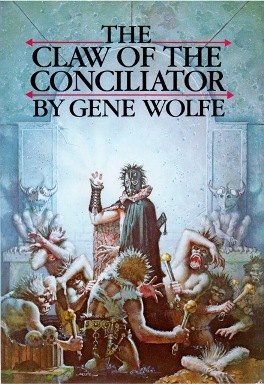
Review: The Claw of the Conciliator by Gene Wolfe

There is something hypnotic about Gene Wolfe’s prose in The Claw of the Conciliator. And when he lets his imagination loose, all kinds of weird and surprising things happen. The Claw of the Conciliator is a good book, an improvement over the previous book, but it is still frustrating at times.

At first I was afraid it would degenerate into a tedious Star Wars styled rebel vs. imperium narrative. But things quickly get much more complicated and I was as confused as our hero Severian over what’s going on. That’s a good thing.

There are two stories within the story of the novel: the legend of the man who was formed from dreams, and the play put on by Severian and his companions. Severian encounters aliens, robots, and humans from his Urth’s future. Despite all this thrashing about the novel works for the most part. The biggest complaint I have, other than the occasional descent into abstraction, is that there are a few to many conventions of the SF genre that are imposed upon the story.

The image that is trapped in my mind is from a scene where Severian is shown a book that is actually window into distant space. Within he sees a titanic figure moving against a field of stars. The vision overwhelms him, causing blood to seep out of the pores of his forehead. What does it mean? Who knows. And that’s kind of how the book is. Captivating but also challenging and hard to understand.

Monday, October 26, 2015

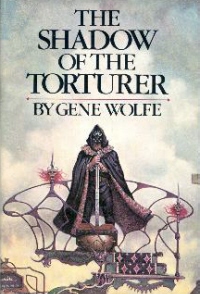
Book Review: The Shadow of the Torturer by Gene Wolfe

I didn’t know what to expect when I started reading this bizarre SF/Fantasy novel — it’s technically science fiction, but it conforms to the conventions of a fantasy adventure novel — and it’s rather fascinating. It was written back in the early 80s when Lord of the Rings and Star Wars had yet to completely overwhelm the genre. It was a time when SF was still a niche pastime in which only weirdos indulged. The Shadow of the Torturer is remarkably weird.

It takes place in a far future Earth (called Urth). The moon is green being shrouded in forests, the mid-day sky is indigo blue as the sun has grown dim, and the characters live in a vast city full of ancient technology and fantastic structures which no one understands or fully comprehends and which may as well be magic.

There are two main parts to the novel. The first is a detailed description of our protagonist Severian as he studies to become a journeyman torturer. This part of the novel is a very involved exploration of the world Severian inhabits. It’s important because the world he lives in is very foreign. It also sets the tone, which is dark. Everything from the sky to what little humor exists is dark. The torturers wear clothes of the color fugilin, which is described as being darker than black. The narrative voice is as dense and oppressive as the scenarios being described.

The second part of the novel, when Severian has started his quest to travel beyond the city, wastes much of that initial world building, unfortunately. It takes Severian the last half of the book just to get to the city’s borders (it’s a very big city) and his adventures seem haphazardly constructed, episodic, and random after the fashion of a mediocre sword and sorcery novel. This was a big letdown after the fantastic build up of the first half.

The book ends on a cliffhanger and the prose and the setting are sufficiently intoxicating that I’m going to give the sequel a try. Despite the missteps in the second half of the novel, there’s really nothing like The Shadow of the Torturer.

Tuesday, October 13, 2015

Book Review: Tarzan's Quest by Edgar Rice Burroughs


These late model Tarzan books are proving to be consistently good.

Jane makes her first appearance in 10 novels, since Tarzan and the Golden Lion. This is also the first mention of any of Tarzan’s family members in 9 novels, since Tarzan and the Ant Men. I was beginning to think that Mr. Burroughs was trying to imply that there was some kind of separation or that Tarzan had regressed so much to his pre-civilized days that he never left the jungle anymore.

The book starts with Tarzan investigating the mysterious disappearance of young girls in the jungle and Jane returning to Africa by plane. Jane’s plane coincidentally crashes in the vicinity of Tarzan’s investigations. And so commence two parallel narratives that only come together in the action packed conclusion.

Jane is portrayed as a leader and capable jungle survivor, climbing around in the trees, making her own weapons, and calmly staring down a charging leopard with nothing but her hand made bow. It was refreshing to see this side of Jane. Alas, she does revert to damsel in distress eventually. And ERB has a tendency to refer to her as a girl even though she and Tarzan are grandparents.

Though there is a weird epilogue that I suspect will address this issue going forward.